
 By
By 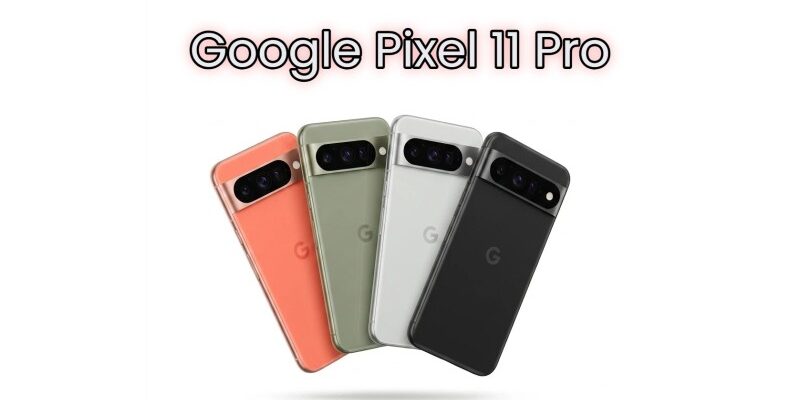
Key Highlights
- Google Tensor G6 processor with Titan M3 security chip
- 6.3-inch Super Actua LTPO OLED display with adaptive 1-120Hz refresh rate
- Triple rear cameras with 50MP main, 48MP ultrawide and 48MP 5x telephoto
- New HiLight rear LED system for calls, notifications and Gemini status
- 12GB/16GB RAM with 256GB and 512GB storage options
Google has launched the Pixel 11 Pro in India as the compact premium flagship in its new Pixel 11 family. It arrives alongside the standard Pixel 11 and larger Pixel 11 Pro XL, with Google’s new Tensor G6 chipset, upgraded camera hardware and a new rear-panel HiLight system. Google’s official launch material highlights the new camera hardware, Tensor G6 and deeper Gemini integration as major parts of the generation.
The Pixel 11 Pro retains the relatively compact 6.3-inch display, making it an interesting option for buyers who want flagship hardware without moving to a large-screen phone. At the same time, Google has not compromised on the core Pro camera system: there is a 50MP main camera, 48MP ultrawide and dedicated 48MP 5x telephoto.
The camera system is another major upgrade. The Pro model gets a 48MP telephoto camera with 5x optical zoom and up to 120x Pro Zoom, alongside a 50MP main sensor and 48MP ultrawide camera.
| Feature | Details |
|---|---|
| Brand | |
| Model | Pixel 11 Pro |
| Launch Date | August 12, 2026 |
| Display | 6.3-inch Super Actua LTPO OLED, adaptive 1–120Hz |
| Resolution | 1280 × 2856 pixels |
| Peak Brightness | Up to 3,600 nits |
| HDR Brightness | Up to 2,400 nits |
| Display Protection | Corning Gorilla Glass Victus 2 with anti-scratch shield |
| Processor | Google Tensor G6 |
| Security Chip | Titan M3 |
| RAM | 12GB / 16GB LPDDR5X |
| Storage | 256GB / 512GB |
| Rear Camera | 50MP wide + 48MP ultrawide + 48MP telephoto |
| Main Camera | 50MP, f/1.68, OIS, LDAF |
| Ultrawide Camera | 48MP with Macro Focus |
| Telephoto Camera | 48MP, 5x optical zoom |
| Zoom | Up to 120x Pro Zoom |
| Front Camera | 42MP with autofocus |
| Video Recording | Up to 8K at 24/30fps |
| Camera Features | Magic Capture, Camera Looks, Add Me, Camera Coach, Pro Stable Video |
| Battery | 4,840mAh |
| Charging | 30W wired, up to 25W Qi2.2 PixelSnap wireless |
| Operating System | Android 17 |
| AI Features | Gemini Intelligence, AI voice-to-text, Circle to Search, Magic Capture |
| Special Feature | HiLight rear LED notification system |
| Fingerprint Sensor | Ultrasonic in-display |
| Durability | IP68 dust and water resistance |
| Connectivity | 5G, Wi-Fi, Bluetooth, NFC, USB Type-C 3.2 |
| Navigation | GPS, GLONASS, Galileo, BeiDou, NavIC |
| Dimensions | 152.7 × 71.9 × 8.4mm |
| Weight | 204g |
| Colours | Canyon, Fog, Olive, Matte Obsidian |
| Price in India | From Rs. 1,19,999 |
| Availability | Pre-orders from August 12; sale from August 20, 2026 |
Design & Build
The Pixel 11 Pro continues Google’s distinctive camera-bar design but introduces a thinner camera-bar construction for this generation. Google says the new Pixel 11 family has a camera bar that is 40% thinner than the previous generation.
The Pixel 11 Pro measures 152.7 x 71.9 x 8.4mm and weighs 204 grams.
Colour options include:
- Canyon
- Fog
- Olive
- Obsidian with a matte finish
The phone also has an IP68 rating for dust and water resistance.
At 204 grams, the Pixel 11 Pro isn’t a lightweight phone, but its 6.3-inch size makes it considerably easier to handle than the Pro XL. That combination could appeal to buyers who want a premium camera phone without carrying a very large handset.
The rear camera area is also more than a visual design element this time because it houses the new HiLight system.
Display
The Pixel 11 Pro features a 6.3-inch Super Actua LTPO OLED display with a 1280 x 2856-pixel resolution.
The LTPO panel supports an adaptive 1Hz to 120Hz refresh rate. This matters because the display can increase the refresh rate for smooth scrolling and animation, then drop it considerably for relatively static content to help conserve battery.
Google lists up to 2,400 nits HDR brightness and 3,600 nits peak brightness, while Gorilla Glass Victus 2 provides screen protection.
For everyday use, the combination should be particularly useful for outdoor viewing, HDR video and gaming. The 120Hz refresh rate should also make scrolling feel substantially smoother than a conventional 60Hz panel.
The LTPO technology is arguably more important for battery efficiency than simply having a high refresh rate.
Performance
The Pixel 11 Pro is powered by Google’s Tensor G6 processor and the Titan M3 security coprocessor.
Google’s new Tensor platform is built around a 2nm manufacturing process, with the company claiming improvements in power efficiency, browsing performance and app loading compared with the previous generation.
The phone comes with 12GB RAM in the 256GB configuration and 16GB RAM in the 512GB configuration, according to the announced India configurations.
That extra memory on the top model should be useful for heavy multitasking and AI workloads.
However, it is worth separating AI performance from gaming performance. Tensor is heavily designed around Google’s AI and computational photography workloads. Until extensive independent testing is available, it would be premature to say that the Pixel 11 Pro will outperform Snapdragon-based rivals in sustained gaming.
For everyday apps, multitasking, photography and Google’s AI features, however, the hardware is firmly positioned in the premium flagship category.
Camera
The camera system is one of the strongest reasons to consider the Pixel 11 Pro.
Main Camera
The primary camera uses a 50MP sensor with an f/1.68 aperture, optical image stabilisation and laser detection autofocus support.
A wide-aperture main camera combined with OIS should help with low-light photography and handheld shots, while Google’s image processing remains an important part of the final image quality.
Ultrawide Camera
The second camera is a 48MP ultrawide.
The higher resolution gives Google more data to work with for cropping and computational processing, while the ultrawide camera expands the phone’s usefulness for landscapes, architecture and group photography.
Telephoto Camera
The third camera is a 48MP telephoto with 5x optical zoom.
This is particularly important because optical zoom is fundamentally different from simply cropping a photograph digitally. A dedicated 5x lens provides genuine optical reach before computational zoom takes over.
Google lists up to 120x Pro Zoom, while optical-quality zoom levels include 0.5x, 1x, 2x, 5x and 10x.
Selfie Camera
The front camera is a 42MP sensor with autofocus.
That should make it useful not only for conventional selfies but also for video calls and creator-focused shooting.
Video
The Pixel 11 Pro supports 8K video recording at 24fps and 30fps, in addition to lower-resolution recording modes.
Google is also adding software-based camera features including Magic Capture and Camera Looks.
Magic Capture is designed to automatically identify strong moments from a sequence and prepare them for sharing, while Camera Looks lets users create a more distinctive photographic style rather than relying entirely on standard processing.
As always, 50MP or 48MP numbers alone don’t guarantee better photography. Sensor quality, optics, stabilisation and image processing all influence the final result.
Special Features: What Is HiLight?
The HiLight system is exclusive to the Pixel 11 Pro lineup.
It consists of LEDs around the rear camera flash that can illuminate in different patterns and colours.
For example, users can assign colours to important contacts so an incoming call can be recognised without immediately looking at the screen.
HiLight can also provide visual feedback when Gemini is listening, processing a request or responding.
That’s an interesting change in how a smartphone communicates with its owner. Instead of every interaction requiring the display to light up, some information can be communicated through the rear of the handset.
It is not an essential feature, but it gives the Pixel 11 Pro a genuine identity beyond another premium phone with a triple-camera setup.
Software & AI
The Pixel 11 Pro ships with Android 17 and Google’s latest Pixel software experience.
Gemini is deeply integrated into the device, with Google adding new AI capabilities for communication, photography and everyday tasks.
One example is improved voice-to-text processing that can remove filler words and turn conversational speech into cleaner text.
Google is also integrating Circle to Search directly into the Pixel Camera, allowing users to search for objects or subjects they encounter through the camera experience.
The Pro lineup also supports features such as Add Me, Camera Coach, Magic Capture and Camera Looks.
Google’s long-term software commitment is another major selling point. The Pixel 11 generation is backed by seven years of OS upgrades, security updates and Pixel Drops.
For buyers who keep phones for five or six years, this could matter more than a small difference in benchmark performance.
Battery & Charging
The Pixel 11 Pro packs a 4,850mAh battery.
It supports:
- 30W wired charging
- Up to 25W Pixelsnap wireless charging
- Qi2.2-certified wireless charging
The phone is also designed around Tensor G6’s efficiency improvements.
That said, the 4,850mAh capacity is not especially large compared with some competing Android flagships. Actual endurance will depend on brightness, camera usage, gaming, 5G connectivity and AI workloads.
The 25W wireless charging support is useful for people who prefer magnetic charging accessories, but 30W wired charging is relatively conservative for a phone costing more than Rs. 1 lakh.
That is one area where performance-focused competitors may have an advantage.
Storage & Connectivity
The Pixel 11 Pro is available in two India configurations:
| RAM | Storage | India Price |
|---|---|---|
| 12GB | 256GB | Rs. 1,19,999 |
| 16GB | 512GB | Rs. 1,34,999 |
The 512GB model’s move to 16GB RAM makes it the more future-proof option for buyers who store a lot of 4K/8K video or intend to keep the phone for several years.
There is no microSD expansion, so buyers should select their storage carefully.
Connectivity
The Pixel 11 Pro supports:
- 5G
- 4G LTE
- Wi-Fi
- Bluetooth 6
- NFC
- GPS
- GLONASS
- Galileo
- BeiDou
- QZSS
- NavIC
- USB Type-C 3.2
- eSIM and Nano-SIM support
The phone also includes an ultrasonic in-display fingerprint sensor.
Wi-Fi 7 support is listed for the Pixel 11 generation, while Bluetooth 6 and USB-C 3.2 provide modern connectivity for accessories and high-speed data transfers.
Price & Availability in India
The Google Pixel 11 Pro price in India starts at Rs. 1,19,999.
| Variant | Price in India |
|---|---|
| 12GB + 256GB | Rs. 1,19,999 |
| 16GB + 512GB | Rs. 1,34,999 |
The phone is offered in Canyon, Fog, Olive and Matte Obsidian finishes.
Pre-orders opened in India following the launch, with general sales scheduled to begin on August 20, 2026.
The phone is being sold through Google’s India sales channels and retail partners.
Based on the India launch details supplied for the Pixel 11 family, launch benefits include:
- Up to Rs. 10,000 instant discount on eligible HDFC Bank credit-card EMI purchases
- Up to 24 months No-Cost EMI
- Up to Rs. 9,000 exchange bonus
- Six months of Google AI Pro as part of the launch offer
Google has also introduced Pixelsnap accessories, including the Pixelsnap Case, Pixelsnap Charger and Pixelsnap Ring Stand.
Competition & Alternatives
At Rs. 1,19,999, the Google Pixel 11 Pro is competing directly with other premium flagship smartphones rather than ordinary high-end Android phones.
Samsung Galaxy S26 Ultra
The Samsung Galaxy S26 Ultra is a particularly relevant alternative for buyers who want maximum hardware flexibility.
Choose Pixel 11 Pro if: you prefer Google’s camera processing, compact 6.3-inch form factor and Pixel AI experience.
Choose Galaxy S26 Ultra if: you want a much larger display, stronger hardware-focused performance and Samsung’s extensive camera and productivity ecosystem.
iPhone 17 Pro
The iPhone 17 Pro is another direct choice for buyers deciding between Android and iOS at the premium level.
Choose Pixel 11 Pro if: Google’s AI tools, Android and computational photography are more important to you.
Choose iPhone 17 Pro if: you prioritise iOS, Apple’s ecosystem and a strong video-production workflow.
OnePlus 14 Pro
The OnePlus flagship is relevant for buyers who care more about performance and charging than Google’s software experience.
Choose Pixel 11 Pro if: photography, AI and long-term Pixel software support are your priorities.
Choose OnePlus 14 Pro if: fast charging, gaming and aggressive performance are higher on your list.
The Pixel 11 Pro’s advantage is therefore not that it wins every hardware specification. Its appeal comes from the combination of camera processing, AI, software support and a relatively compact Pro form factor.
Price Justification: Is the Pixel 11 Pro Worth Rs. 1,19,999?
The Google Pixel 11 Pro is clearly a premium purchase.
At Rs. 1,19,999, buyers are paying not just for Tensor G6 and 12GB RAM but for Google’s complete software-and-camera ecosystem.
The strongest justification comes from the 50MP + 48MP + 48MP camera system, 5x optical telephoto, 120x Pro Zoom, 120Hz LTPO display, Gemini integration, HiLight and seven years of software support.
However, the price becomes harder to justify if you mainly want maximum gaming performance or extremely fast wired charging.
The Pixel 11 Pro makes the most sense for someone who will actually use its camera and AI features and keep the device for several years.
Pros & Cons
Pros
- Excellent camera hardware on paper
- Dedicated 5x optical telephoto
- 120Hz LTPO OLED display
- Tensor G6 with strong AI focus
- New HiLight rear notification system
- 12GB RAM on the base model
- Up to 512GB storage
- 25W wireless charging
- IP68 protection
- Seven years of software support
Cons
- Expensive starting price
- Only 30W wired charging
- Battery capacity isn’t class-leading
- Heavy for a compact 6.3-inch phone
- No microSD expansion
- Gaming performance needs independent testing
Who Should Buy the Pixel 11 Pro?
Best For
- Camera enthusiasts
- Mobile photographers
- AI-focused users
- Pixel fans
- Premium Android buyers
- People who want a compact flagship
- Users planning to keep their phone for many years
- Creators who can benefit from Google’s camera and editing tools
Consider Alternatives If
- You are primarily a serious mobile gamer
- You want much faster wired charging
- You want the biggest possible display
- You prefer Apple’s ecosystem
- You want maximum hardware specifications per rupee
FAQs
What is the Google Pixel 11 Pro price in India?
The Pixel 11 Pro starts at Rs. 1,19,999 for the 12GB RAM + 256GB storage variant.
How much RAM does the Pixel 11 Pro have?
It comes with 12GB RAM on the 256GB model and 16GB RAM on the 512GB model.
What processor does the Pixel 11 Pro use?
The phone is powered by Google’s Tensor G6 processor, paired with the Titan M3 security chip.
Does the Pixel 11 Pro have a telephoto camera?
Yes. It has a 48MP telephoto camera with 5x optical zoom and up to 120x Pro Zoom.
What is special about HiLight?
HiLight uses rear LEDs around the camera area to provide custom colour alerts for contacts and visual indicators for Gemini activity.
When will the Pixel 11 Pro go on sale in India?
The Pixel 11 Pro is scheduled to become generally available in India from August 20, 2026, following its pre-order period.








Comments