
 By
By 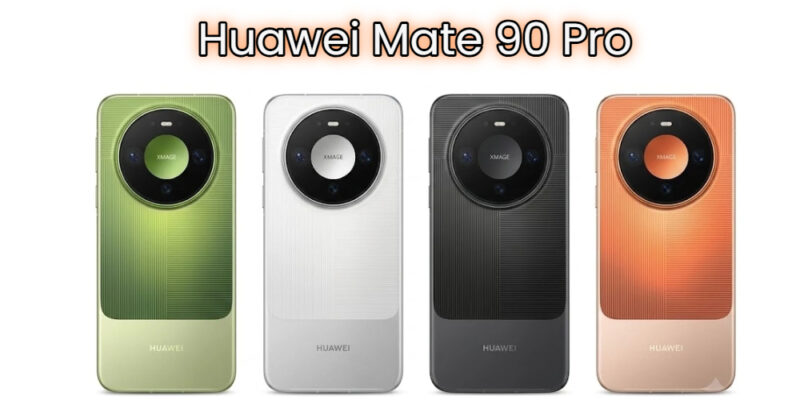
Key Highlights
- 6.75-inch dual-layer OLED display with 1-120Hz LTPO refresh rate
- Huawei Kirin 9035 chipset with hardware ray tracing
- 50MP variable-aperture main camera with OIS
- 50MP macro telephoto camera with 4x optical zoom
- 6,600mAh battery with 100W wired and 50W wireless charging
- HarmonyOS 7 with AI features and two-way BeiDou satellite messaging
Huawei has launched the Mate 90 Pro in China as a premium model in its new Mate 90 flagship lineup. The phone combines the new Kirin 9035 chipset with a 6.75-inch dual-layer OLED display, a 6,600mAh battery and a four-camera rear system built around Huawei’s XMAGE imaging platform.
The Mate 90 Pro also brings a 1-120Hz LTPO refresh rate, a claimed peak brightness of 12,000 nits, 100W wired charging and HarmonyOS 7. Its camera system adds a 50MP macro telephoto lens, while the phone also supports two-way BeiDou satellite messaging for supported communication scenarios.
| Feature | Details |
|---|---|
| Brand | Huawei |
| Model | Mate 90 Pro |
| Launch Date | October 1, 2026 |
| Launch Market | China |
| Display | 6.75-inch Dual-Layer OLED |
| Resolution | 2832 × 1280 pixels |
| Refresh Rate | 1-120Hz LTPO |
| Peak Brightness | Up to 12,000 nits* |
| Processor | Kirin 9035 |
| RAM | 12GB / 16GB |
| Storage | 256GB / 512GB / 1TB |
| Rear Cameras | 50MP + 40MP + 50MP + Red Maple camera |
| Front Camera | 13MP ultra-wide + 3D depth camera |
| Battery | 6,600mAh |
| Wired Charging | 100W |
| Wireless Charging | 50W |
| Operating System | HarmonyOS 7 |
| Connectivity | 5G, Wi-Fi 7, Bluetooth 6.0 |
| Dimensions | 161.9 × 75.7 × 7.95mm |
| Weight | Approx. 222g |
| Durability | IP68 / IP69 |
| Colours | Florence Green, Amber Orange, Crystal White, Obsidian Black |
| Starting Price | ¥6,999 |
| Availability | China |
Design & Build
The Huawei Mate 90 Pro measures 161.9 × 75.7 × 7.95mm and weighs approximately 222 grams. It uses an aluminium-alloy frame and a fiberglass rear panel, while Huawei combines its third-generation Kunlun Glass with its basalt-inspired body architecture.
The phone is available in Florence Green, Amber Orange, Crystal White and Obsidian Black. Huawei’s design uses a symmetrical rear camera arrangement and a patterned finish intended to give the phone a distinctive appearance.
Durability is another major part of the Pro model. Huawei lists IP68 and IP69 protection and says the phone can withstand controlled water-immersion and high-temperature, high-pressure water-jet testing. Huawei also notes that this protection is not permanent and that liquid damage is not covered by its warranty.
Display
The Mate 90 Pro features a 6.75-inch dual-layer OLED display with a 2832 × 1280 resolution. The panel supports an adaptive 1-120Hz LTPO refresh rate, 1440Hz high-frequency PWM dimming and a 300Hz touch sampling rate.
The headline specification is Huawei’s claimed 12,000-nit peak brightness. Huawei says this measurement comes from a 1% APL laboratory test, meaning it represents a specific peak-brightness scenario rather than sustained full-screen brightness.
The combination of LTPO and high peak brightness is particularly relevant for outdoor use. The variable refresh rate can also reduce display power consumption during static content while allowing up to 120Hz for scrolling and supported applications.
Performance
The Mate 90 Pro is powered by Huawei’s Kirin 9035 processor and runs HarmonyOS 7. Huawei says the chip is designed to work with the operating system and cloud capabilities as part of its integrated hardware-software approach.
Huawei also highlights hardware-level ray tracing, with the company claiming up to 31 million rays rendered per second. This is intended to improve lighting and shadow effects in compatible games.
However, Huawei’s performance claims should not be confused with independent benchmark results. Real-world gaming performance, sustained thermals and battery efficiency will require independent testing.
Camera
The Mate 90 Pro has a four-camera rear system consisting of a 50MP main camera, 40MP ultra-wide camera, 50MP macro telephoto camera and Huawei’s third-generation Red Maple primary-colour camera.
The 50MP main camera uses a variable f/1.4-f/4.0 aperture, an RYYB sensor and optical image stabilization. The adjustable aperture gives the camera more control over light intake and depth-of-field effects compared with a fixed-aperture design.
The 50MP telephoto camera also uses an RYYB sensor and OIS. Huawei lists approximately 4x optical zoom, 8x optical-quality zoom and up to 100x digital zoom. The telephoto lens can also focus as close as 5cm, making it useful for macro photography.
The phone supports 4K video recording, AIS stabilization and 1080p slow-motion recording at up to 960fps using AI frame interpolation. Its camera software includes XMAGE processing, AI composition, portrait tools, Super Night Scene, RAW photography, macro modes and several cinematic effects.
On the front, Huawei uses a 13MP ultra-wide camera with autofocus alongside a 3D depth-sensing camera.
Independent camera testing is still important before judging actual image quality, so the specifications and Huawei’s own imaging claims should not be treated as measured camera performance.
Battery & Charging
The Mate 90 Pro packs a 6,600mAh battery, giving it a substantial capacity for a premium smartphone.
Wired charging reaches 100W Huawei SuperCharge, while wireless charging supports up to 50W. The phone also supports up to 18W wired reverse charging and wireless reverse charging. Huawei says its laboratory testing can fully charge the phone in approximately 0.75 hours using a 100W SuperCharge kit and Turbo charging mode.
The 100W charging support is particularly useful for users who need to replenish a large battery quickly, although the maximum charging speed requires a compatible Huawei charging kit.
Software & AI
The Mate 90 Pro runs HarmonyOS 7, Huawei’s latest smartphone operating system. The software includes Xiaoyi-based AI functions for tasks such as call summaries, call translation, messaging and assistance.
Huawei also highlights AI-powered photography features, including composition assistance, portrait tools and dynamic photo functions. Some listed features require software updates, so availability can depend on the device’s software version.
The phone also supports Huawei’s cross-device features, including multi-screen collaboration, Huawei Share, wireless screen projection, clipboard sharing and app cloning.
Connectivity & Special Features
The Mate 90 Pro supports 5G, Wi-Fi 7, Bluetooth 6.0, NFC and USB Type-C. The USB-C port supports USB 3.1 Gen 1 and DisplayPort 1.2.
One of its more distinctive communication features is two-way BeiDou satellite messaging, which can be used to send messages and images in supported situations where conventional cellular connectivity is unavailable. Huawei also includes an infrared sensor for remote-control functions.
The phone supports dual-SIM functionality and eSIM, although eSIM availability depends on carrier support and region.
Price & Availability
The Huawei Mate 90 Pro launched in China on October 1, 2026, with a starting price of ¥6,999. Huawei’s official Chinese:
- 12GB + 256GB – ¥6,999 (Approx. ₹1,00,500)
- 12GB + 512GB – ¥7,999 (~₹1,14,800)
- 16GB + 512GB – ¥8,499 (~₹1,22,000)
- 16GB + 1TB – ¥9,999 (~₹1,43,500)
Competition & Alternatives
The Mate 90 Pro competes in the premium flagship segment, where buyers may also consider high-end models from Apple, Xiaomi, Oppo, Vivo and Huawei’s other Mate 90 variants.
| Alternative | Why Consider It? | Mate 90 Pro Difference |
|---|---|---|
| Huawei Mate 90 | Lower starting price | Faster charging and dual-layer OLED display |
| Huawei Mate 90 Pro Max | Larger flagship form factor | More compact 6.75-inch design |
| iPhone flagship | iOS ecosystem and established app support | HarmonyOS, Huawei camera hardware and satellite features |
| Android flagship alternatives | Broader Android ecosystem | Huawei’s XMAGE imaging and HarmonyOS features |
The most important comparison points for buyers will be software ecosystem, local availability, camera performance and pricing rather than specifications alone.
Pros & Cons
Pros
- 6.75-inch dual-layer OLED display, 1-120Hz LTPO refresh rate, Claimed 12,000-nit peak brightness
- Kirin 9035 processor
- Versatile four-camera system
- 50MP macro telephoto camera
- 6,600mAh battery, 100W wired and 50W wireless charging
- IP68 and IP69 protection
- Two-way BeiDou satellite messaging
Cons
- Huawei’s app ecosystem differs from mainstream Android phones
- Maximum charging speeds require compatible Huawei accessories
- Peak-brightness figure is based on a specific laboratory test rather than sustained full-screen brightness
Final Verdict: Should You Buy It?
The Huawei Mate 90 Pro is designed for users who want a premium Huawei smartphone with an emphasis on display technology, photography, charging and connectivity. Its dual-layer OLED panel, variable-aperture camera, macro telephoto, 6,600mAh battery and 100W charging give the phone a distinctive hardware package.
Its main consideration for buyers outside China is availability and software compatibility. The phone’s hardware is clearly positioned at the premium end, but buyers should also consider whether HarmonyOS and Huawei’s app ecosystem meet their everyday requirements.
Best for: Photography-focused users, Huawei ecosystem users, outdoor users and buyers interested in advanced display and charging technology.
Consider alternatives if: You need broad Google/Android app compatibility, confirmed local availability or a more established international software ecosystem.
Bottom line: The Mate 90 Pro combines Huawei’s latest Kirin 9035 platform with an advanced display, versatile XMAGE camera system and fast charging, making it one of the more feature-focused models in Huawei’s new Mate lineup.
FAQs
What is the Huawei Mate 90 Pro price?
The Mate 90 Pro starts at ¥6,999 in China for the 12GB RAM and 256GB storage version.
What processor does the Mate 90 Pro use?
The phone is powered by Huawei’s Kirin 9035 chipset.
How large is the Mate 90 Pro battery?
It has a 6,600mAh battery with support for 100W wired and 50W wireless charging.
Does the Mate 90 Pro support satellite messaging?
Yes. Huawei lists two-way BeiDou satellite messaging, including support for sending images in supported scenarios.
Does the Mate 90 Pro have a 120Hz display?
Yes. Its dual-layer OLED panel supports an adaptive refresh rate from 1Hz to 120Hz.





Comments